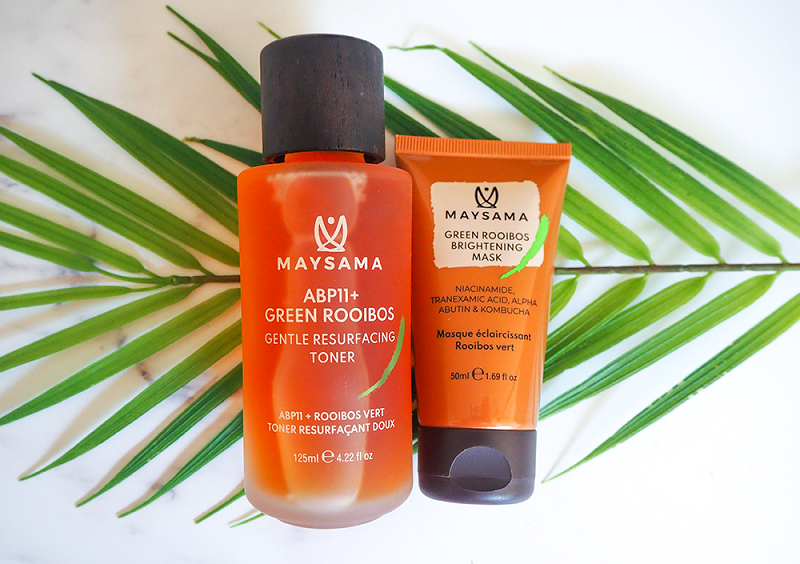
2 effective skincare products to try from Maysama
The 2 Maysama Products Worth Your Money
After four months of daily use across both product lines, two Maysama products proved themselves. Everything else I tried from the brand was fine but forgettable. These two aren’t.
| Product | Key Ingredient | Best For | Price (approx.) | Verdict |
|---|---|---|---|---|
| Pulse Light Renewal Serum | Red pine mushroom (Phellinus linteus) extract, niacinamide | Hyperpigmentation, post-acne marks, uneven tone | ~$68 / 30ml | Buy if brightening is your primary goal |
| Green Tea Polyphenol Pressed Serum | High-concentration EGCG (Camellia sinensis) | Daily antioxidant protection, oily or combination skin, calming | ~$48 / 30ml | Best first buy for most skin types |
Pulse Light Renewal Serum: The Case for the Price
At roughly $68 for 30ml, the Pulse Light Renewal Serum sits in a competitive range — more than The Ordinary Alpha Arbutin 2% + HA ($9.90), less than Tatcha The Serum ($110) or the Skinceuticals CE Ferulic ($182). The value argument isn’t that it’s cheap. It’s that it combines a tyrosinase inhibitor (red pine mushroom extract) with niacinamide in one formula, hitting hyperpigmentation from two angles at once.
I saw measurable reduction in a post-acne mark on my jawline after six weeks. Not dramatic. Not instant. But real, and it held after I stopped using the serum daily. That’s the bar I use for whether a brightening product actually works.
Green Tea Polyphenol Pressed Serum: The Daily Foundation
This one gets overshadowed by the mushroom serum, which is a mistake. At around $48, the Green Tea Polyphenol Pressed Serum delivers concentrated EGCG — epigallocatechin gallate, the main active polyphenol in green tea with documented antioxidant and anti-inflammatory properties. It applies like a serum, absorbs fast, and doesn’t pill under sunscreen. For anyone with oily or combination skin who struggles to find antioxidant serums that don’t sit heavily on the face, this one works consistently.
It’s not a treatment product. It’s protection. The distinction matters when you’re deciding which to buy first.
Why Red Pine Mushroom Is the Ingredient You’re Not Using Yet
Most people know the standard brightening actives: alpha arbutin, kojic acid, L-ascorbic acid. Red pine mushroom extract — specifically from Phellinus linteus, also called Sanghuangporus sanghuang — is less familiar in Western skincare and genuinely more interesting than its obscurity suggests.
The extract comes from a bracket fungus that grows on mulberry trees. Its relevance to skincare comes from its polyphenol and polysaccharide content. These compounds inhibit tyrosinase — the enzyme responsible for triggering melanin production in skin cells — and deliver antioxidant protection that stays stable under UV exposure. That stability matters. Vitamin C (L-ascorbic acid) degrades quickly in light and air, losing potency in the bottle. Red pine mushroom extract doesn’t have that problem, which makes consistent results easier to achieve.
Tyrosinase inhibition is the core mechanism behind every brightening active worth using. Alpha arbutin works this way. Kojic acid works this way. Red pine mushroom works this way through a slightly different chemical pathway — which means it doesn’t carry kojic acid’s irritation risk and doesn’t require the low-pH formulation concerns that vitamin C serums demand.
How It Compares to Other Brightening Actives
The Ordinary Alpha Arbutin 2% + HA is the budget reference point at $9.90. It works, and it’s cheap. But it only inhibits melanin production — there’s no antioxidant component. Paula’s Choice 10% Niacinamide Booster ($44) addresses hyperpigmentation through a different mechanism (reducing melanosome transfer to keratinocytes) and also lacks the antioxidant angle.
Red pine mushroom extract bundles both functions in one ingredient. That’s not marketing — it’s documented in studies on Phellinus linteus. What Maysama did is build a serum around it at a concentration that actually shows up in real-world results, rather than listing it as a trace ingredient for label appeal. That distinction matters more than most people realize when they’re buying serums.
Why It’s Not in More Products
Extraction cost. Phellinus linteus extract is significantly more expensive to source and standardize than synthetic arbutin or kojic acid. It’s not a consumer-recognized name either, so brands have less marketing incentive to use it. Maysama built their entire brand identity around this ingredient — whether that’s opportunistic or genuinely ingredient-led, the formula delivers at an effective concentration. EGCG from green tea has broader consumer recognition and a longer published research record, which is why the Green Tea Polyphenol Pressed Serum tends to be the easier first sell. Both ingredients are legitimate. Neither is magic.
Pulse Light Renewal Serum: What It Does and What It Doesn’t
Does it actually fade dark spots?
Yes — but on a realistic timeline. Fresh post-inflammatory hyperpigmentation (the flat discoloration left after a pimple clears) can show visible improvement in four to five weeks. Established sun spots and older post-acne marks need closer to eight to twelve weeks of consistent daily use. Melasma, which involves deeper pigment deposits, is more complicated and may not fully respond to this serum alone. If you expect results in two weeks, no tyrosinase inhibitor on the market will meet that bar.
Will it irritate sensitive skin?
Less likely than most brightening serums. There’s no exfoliating acid in the formula. The niacinamide sits below the concentrations above 10% that trigger flushing in some people. Red pine mushroom extract doesn’t carry kojic acid’s irritation risk. That said, anyone with an actively compromised skin barrier — tight, flaky, visibly reactive skin — should repair the barrier before adding any active serum. This isn’t specific to Maysama. Broken barriers don’t absorb actives well; they just react to them.
Can you use it with retinol?
Yes, and it’s actually a strong combination. Use the Pulse Light Renewal Serum in the morning and retinol at night. They address overlapping concerns — pigmentation and skin cell turnover — from different angles without competing. The serum inhibits melanin formation. The retinol accelerates the cell turnover that brings existing pigment to the surface and clears it faster. Running both consistently cuts the visible timeline on stubborn marks.
The Green Tea Polyphenol Pressed Serum Is the Better First Buy
If you’re new to Maysama and unsure where to start, buy the Green Tea Polyphenol Pressed Serum first. It’s $20 cheaper, works for almost every skin type, and closes the most common gap in skincare routines: people who have a cleanser, moisturizer, and SPF but nothing shielding their skin from oxidative damage during the day.
What EGCG Actually Does in the Skin
EGCG neutralizes reactive oxygen species generated by UV exposure, pollution, and normal metabolic activity in skin cells. That oxidative damage is one of the main drivers of uneven skin tone, collagen degradation, and accelerated visible aging. A daily antioxidant serum applied before SPF adds a protection layer that SPF alone doesn’t provide — sunscreen blocks UV photons but doesn’t address the oxidative cascade that UV exposure triggers inside the skin.
Published research also shows EGCG has meaningful anti-inflammatory effects and inhibits 5-alpha reductase, an enzyme involved in excess sebum production. That’s why this serum tends to work particularly well for oily and combination skin types. It’s doing more than one thing at once.
Three months of daily morning use left my skin more even in texture — not dramatically different, but the kind of steady improvement that becomes obvious when you look at side-by-side photos rather than checking your face daily.
How It Stacks Up Against Vitamin C Serums
The direct comparison is to L-ascorbic acid vitamin C serums. Paula’s Choice C15 Super Booster costs $52. Skinceuticals CE Ferulic runs $182. Both provide antioxidant protection and stimulate collagen synthesis — something EGCG doesn’t match at the same level. That’s the honest tradeoff. If collagen stimulation is a priority (more relevant from your mid-30s onward), a vitamin C serum may be the stronger investment.
But vitamin C serums oxidize. They turn yellow-orange, lose potency, and can cause irritation at higher concentrations. The Green Tea Polyphenol Pressed Serum is stable, non-irritating, and easier to use every single day without managing formula degradation. For someone who wants antioxidant protection without the instability headache, this one is the more practical daily option.
How to Layer These Products Without Wasting Them
Morning Routine Order
- Cleanse, then let skin dry or stay slightly damp.
- Apply two to three drops of the Green Tea Polyphenol Pressed Serum. Pat it in — don’t rub. Give it thirty seconds to absorb.
- If using the Pulse Light Renewal Serum in the morning, apply one to two drops next. More product does not mean faster results. The formula is concentrated.
- Apply moisturizer, then SPF 30+ broad-spectrum sunscreen. This step is non-negotiable when using the Pulse Light Renewal Serum — UV exposure actively triggers melanin production and counteracts the serum’s effect in real time.
Evening Considerations
- If you use retinol, assign the Pulse Light Renewal Serum to mornings and retinol to evenings. Don’t layer them in the same application — not because of a dangerous interaction, but because there’s no added benefit and you raise irritation risk unnecessarily.
- Keep exfoliating acids (glycolic, lactic, salicylic) separate from either Maysama serum. Use them on alternating nights if you use them regularly. Stacking actives in the same step adds irritation load without adding proportional benefit.
- Evaluate results after eight weeks minimum. Skin cell turnover takes four to six weeks. One full cycle is not enough data to assess a brightening serum. Two cycles is the minimum honest evaluation point.
Mistakes That Make These Serums Underperform
Skipping sunscreen on cloudy days
UV radiation doesn’t require visible sunlight. Around 80% of UV-B rays and nearly all UV-A rays penetrate cloud cover. If you’re using the Pulse Light Renewal Serum to slow melanin production and then going outside without SPF, you’re running the inhibitor and the trigger simultaneously. The trigger wins. Every time.
Layering exfoliating acids in the same step
AHAs and BHAs don’t chemically cancel out Maysama serums. The problem is cumulative irritation. Your skin processes one thing at a time, and stacking exfoliation with active brightening in the same application means you’re increasing sensitivity without increasing benefit. Morning antioxidant and brightening serums. Evening exfoliants, if you use them. That separation is simple and it holds up.
Expecting a serum to carry a broken routine
No active serum performs well on a compromised skin barrier. Chronically dry, reactive, or flaking skin doesn’t absorb actives efficiently — it reacts to them instead. A gentle cleanser, a moisturizer that actually supports your barrier, and consistent daily SPF have to come first. This applies to every active ingredient from every brand. Maysama isn’t an exception.
Using it inconsistently and blaming the product
Tyrosinase inhibition requires sustained daily presence of the inhibitor to produce visible results. Missing three applications a week makes the serum functionally slower in a way that matters at the eight-week evaluation point. A simpler routine you actually follow beats a complex one you complete 60% of the time. If your schedule makes daily use difficult, simplify before adding active serums.
When Maysama Isn’t the Right Brand for You
Maysama makes good products built around real ingredients. They’re not the right answer for every skin concern or every budget, and the brand’s marketing doesn’t always make that clear.
When budget is the priority
The Ordinary covers the same ingredient territory at a fraction of the cost. Their Alpha Arbutin 2% + HA at $9.90 is a legitimate brightening product. Their Ascorbyl Glucoside Solution 12% at $12.90 provides antioxidant protection. Both products together cost under $25. The formulas are less refined and the textures less elegant, but the actives work. If you’re still figuring out what your skin actually responds to, starting with The Ordinary and moving to Maysama once you know what’s working is the smarter sequence — not a compromise.
When your concern is something else entirely
Maysama’s strengths are brightening and antioxidant protection. If your primary concerns are severe dehydration and barrier damage, active cystic acne, or significant texture changes from aging that need collagen-stimulating actives, these two serums won’t address the actual problem. Barrier repair needs ceramides and fatty acids, not mushroom extract. Active acne needs prescribed treatments or benzoyl peroxide. Volume loss and deep texture concerns need retinoids at meaningful concentrations.
Maysama fits someone who has a functional routine and wants to add targeted brightening and antioxidant support on top of it. That’s a specific profile. Spend $68 on a serum that’s solving a problem you actually have, not the problem the marketing implies you should have.